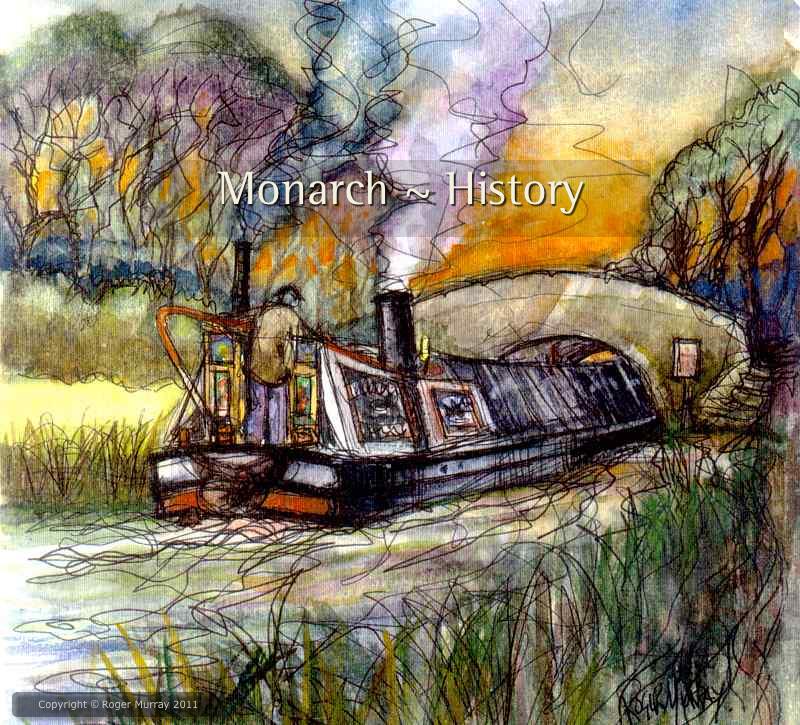


The steamer Monarch was built in 1908 at the Fellows Morton and Clayton yard at Saltley near Birmingham as one of the companies new steamer fleet. This fleet of steamers represented the first real change from horse hauled boats on the English canals to mechanical power. Various experiments with steam powered cargo carrying boats had been made on the canals in the late nineteenth century, but with little success. It was only when Fellows Morton & Clayton, who owned, by far the largest cargo carrying fleet, designed, built and introduced their steamers in the eighteen nineties did the demise of the horse drawn narrowboat begin.
This small fleet of thirty two steam boats created the most significant change the canals have ever witnessed in their long history. When the company designed their first steamer all those years ago they used a normal Josher butty hull. After a number of experiments they realised that they would have to re-design the stern end and introduce a cavitation plate over the propeller. Hence the first counter stern was developed, living to this day as the standard counter stern for all narrow boats, although you can generally recognise an ex steamer hull by the extra canted up stern to allow for the large diameter propeller.
The approach of a 70 ft FMC Steamer, was
immediately recognisable by it's stark black funnel
invariably throwing out a plume of white steam
which could be seen laying a trail across the fields
whilst she was still a mile away. In those simple days
they must have been a formidable sight, and possibly
a foreboding of things to come, to the boatmen with
the horse drawn boats. They were a mean and
powerful machine being able to tow up to four fully
loaded butty boats (the name of the original horse
drawn narrowboat).

Photo of a sister ship "Sultan" From the series known as the "Buckby Photographs". Not all the Buckby photos have survived some are missing including those of Monarch. The photos were all taken the same way inso much as the steamer was tethered by a stern rope to minimise movement to gain a clear image using the slow exposure of the film emulsions of the era.
The steamer fleet used to operate from London to various centres in the Midlands and the north, non stop with immediate turnarounds having virtual right of way over any other craft. The boilers never went out. They carried an all male crew of four instead of the customary husband and wife crew on the horse drawn butty, with the woman's colourful touch of decoration and polished brasses noticeably absent.
The steamers had a no nonsense functional look about them with no brass bands around the funnel or stove chimney and minimal painted decoration. This significant era of steam on the canals was short lived as by the mid-1920s the more compact and economical Bolinder semi- diesel engine took over as the main motive power. It took up much less engine space allowing for more cargo and a man and his wife could again handle the boat.
By 1925 most of the 32 steamers had either been scrapped or converted to diesel. Only a few have managed to survive to the present day. Although they can no longer be identified by the unmistakable black funnel which disappeared seventy years ago when they were converted to diesel. Nevertheless the experienced eye can spot an ex steamer by the fine Josher bow and the canted up counter stern to allow for the enormous propeller.
Her Majesty, Queen Elizabeth II, once visited Monarch.
On reaching the boatman's cabin, where a joint of roast
beef was cooking in the range, she declared "How amazing".
It has never been established whether or not it referred to
the roast beef or to the boatman's cabin! Apparently any
reference to cups of tea and Typhoo are not fact.




